Putting in that initial offer was so stressful. Since we were buying a condo, we had another layer to work with: board approval and a whole set of paperwork to fill out. Working with our Realtor, we put together a pretty strong offer, and submitted that while we were heading out on vacation.
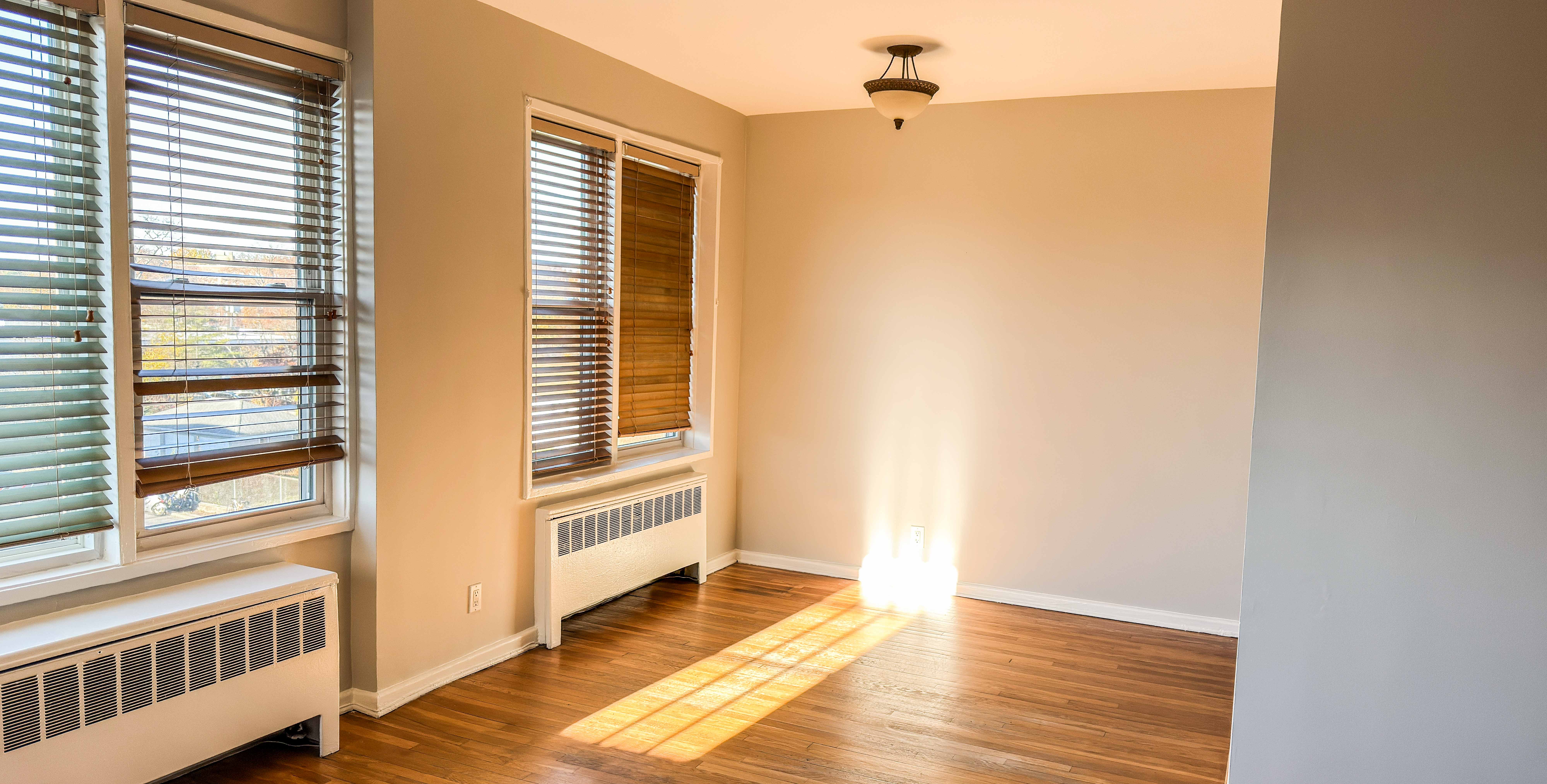
Fatima and I are emotional-numbers people. But at the end of the day, we asked ourselves does this space feel right and does this number make sense? The numbers worked, even with that 6% interest rate. And the space? It felt so right, like I said before, the space gave us that welcome-home-energy.
Before we get into the renovations, I’m going back through our time from the offer all the way to the close. If you’re wondering how buying a condo actually works, how long it takes, or whether it’s even the right move, I’m answering all of it here, with our real numbers and our real headaches included.
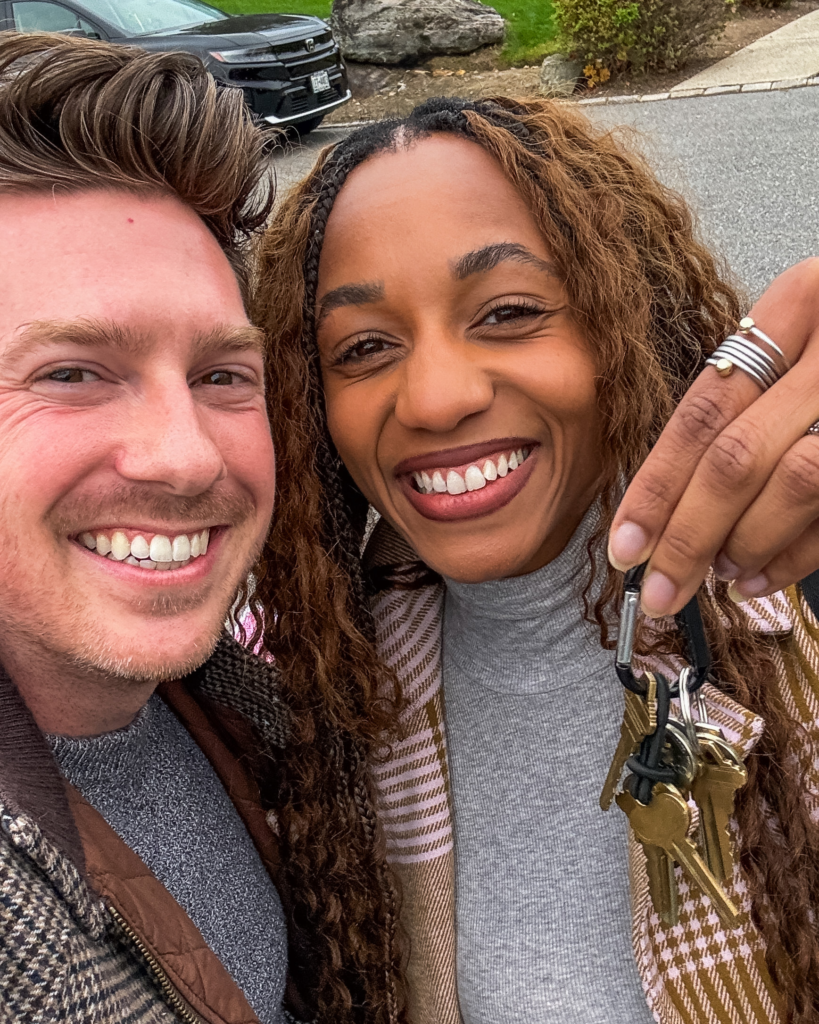
Us, immediately after closing:

A quick note before you dive in: this post reflects our personal experience buying our condo, in our specific building, with our specific mortgage lender and real estate team. Every building, board, lender, and market is different. This isn’t a universal guide to how the process will go for you, just an honest look at how it went for us, shared in the hopes that it helps you know what to ask and what to expect.
Offer Accepted
I don’t know why we were so nervous. That first weekend after the offer was submitted was stressful. But on a hot, summer day in New Hampshire, our Realtor gave us a call. Offer accepted. We were thrilled. At the time we were out at lunch in Portsmouth, with bellies full of lobster and margaritas…and the celebrations continued.
Now it was time to get to work. Calls went out to our team and we began filling out the building’s application. From the time we saw the condo, until offer was accepted was two days. The seller wanted to wait for their open house to be over that weekend. If you told me at that lunch table in Portsmouth that we wouldn’t close for another two and a half months, I probably would have ordered another margarita.
So, How Does Buying a Condo Actually Work?
Here’s the thing nobody tells you clearly enough: buying a condo is buying a house, plus a second application process you didn’t know you signed up for. You’re not just buying a unit, you’re asking an entire board of your future neighbors to approve you as a person. That’s the part that makes condos and co-ops different from a single-family home, and it’s the part that ate most of our timeline.
The building application asked for:
- Financial disclosures, including all of our mortgage paperwork
- Personal recommendations
- Pages and pages of application paperwork covering our job history and personal information
- Signatures on the building’s bylaws and house rules
All of that, on top of the actual mortgage process. More on that mortgage process in a minute, because we genuinely loved how that part went– the board application is where I’ll save my complaining.
The Board Application: Our Least Favorite Part
If you want the honest, un-glossy version of buying a condo, this is it. The building’s management company used a “digital” application. I put digital in quotes because it had zero autofill; it was essentially a digital upload. I had to write my name, my full legal name, over and over– probably a thousand times across that form. Every section, every page, my name again. It made us build a separate profile for each of us as applicants, and I genuinely expected that profile to populate the rest of the form automatically. It did not. Not once. I don’t even know what that profile setup even did for us!
And to use this magical piece of technology? We paid $120 for the privilege. I still don’t know what that fee was for. But that wasn’t the only fee, either.
Here’s what we paid just to apply:
- $550 application fee
- $250 credit report fee
- $65 digital submission fee (on top of the $120 fee to use the digital environment)
Almost $1,000 before the board had even looked at our paperwork. If you’re budgeting for a condo, build this line item in; not everyone warns you about it.
The other frustration, and this one still makes me shake my head: one section of the application asked us, the buyers, to provide the seller’s new home address and contact information. We reached out to the seller’s lawyer to fill this out for us. She never responded. So I reached out to the seller directly to get him to fill this form out which my lawyer later told me I probably shouldn’t have done. What was odd is that we had to place this document in our paperwork. I didn’t feel right collecting this information, nor did I want to know anything about this seller. Why couldn’t the building management company build this process in on their end?
Two months after we’d already closed, the seller’s lawyer emailed me out of nowhere asking, “did you get the information you needed to process this document?” I laughed out loud. Sure did, thanks. Two months ago.
How Long Does the Condo Buying Process Take? (Our Actual Timeline)
Everyone we worked with (our lawyer, our mortgage team) said some version of the same thing at the start: buckle up, condo boards are notorious for taking their time. And then, almost daily, someone on our own team would ask, “did you hear anything yet?” No. Still no. The waiting was its own sport.
Here’s exactly how our timeline broke down:
- Day 1: Saw the condo
- Day 2: Offer accepted
- Day 55: Board interview, via Zoom
- Day 60: Board approval delivered to our lawyer
- Day 82: Closed
Eighty-two (82) days from offer to close, with nearly two months of that being the board application and approval process alone. If you’re buying a condo, that board timeline is the number to build your expectations around, not the mortgage approval.
The Financing Side: Locking In With Chase
I want to give a genuine shoutout here, because this part of the process was the opposite of stressful. We worked with Chase, and we loved this team.
Our advisor walked us through exactly what to expect from day one, and then a second team stayed in touch with us throughout as our check-in contacts. They were always accessible and clear about what was happening and why.
What really helped us move fast on our offer was Chase’s Homebuyer Advantage program. With a handful of extra documents upfront, our preapproval was essentially all but an underwritten mortgage before we’d even found the condo. That meant when we did make our offer, we felt confident waiving a mortgage contingency and moving quickly, because the bank had already done the heavy lifting.
The rate itself moved around on us. We started at 6.5%, watched it drop to 6.125% and locked it in there. Through Chase’s relationship banking benefits, we were able to bring that down further, to 5.5%.
On the condo side specifically, the bank needed some extra documentation beyond what a single-family home would require: the building’s prior year financials, plus a questionnaire covering things like the building’s last inspections. That’s a condo-specific step worth knowing about if you’re budgeting time for your own mortgage process.
We put more than 20% down, which lowered our monthly payment enough to make the numbers feel comfortable rather than stressful. And with that 5.5% rate, we were already looking at a lower monthly payment than our rent. Had we been buying a single family home, we would have likely put just 20% down in anticipation of unforeseen maintenance costs.
Why We Chose a Condo: The Benefits (For Us)
I grew up in a single-family home on two acres, and for a long time that felt like the picture of what I wanted for my own family. But somewhere between apartment living as adults and being genuinely busy parents with full-time corporate jobs, I got used to not maintaining a yard. I love mowing, gardening, all of it, I just don’t have time for it right now, and pretending I did wasn’t doing us any favors.
An example of my gardening over a summer break– photoshop in the aughts was a vibe.

On the flip side, single-family home prices in our area are out of control, like they are in a lot of towns right now. We looked at the fixer-uppers we could actually afford and didn’t see the value in overpaying for a house we’d immediately have to sink more money into, on top of high property taxes.
Our rental neighbors were a big reason for speeding up our buying process. However, with the rising cost of rent, we looked at owning something (condo or single family) as a utility driver for controlling our cost of living. No longer are we needing to stress about searching for the next rental. Will my kids have to change school districts. To be honest, that’s the real reason: a permanent place to settle and not have to think about rent increases nor finding a new apartment.
This condo checked the boxes we actually needed:
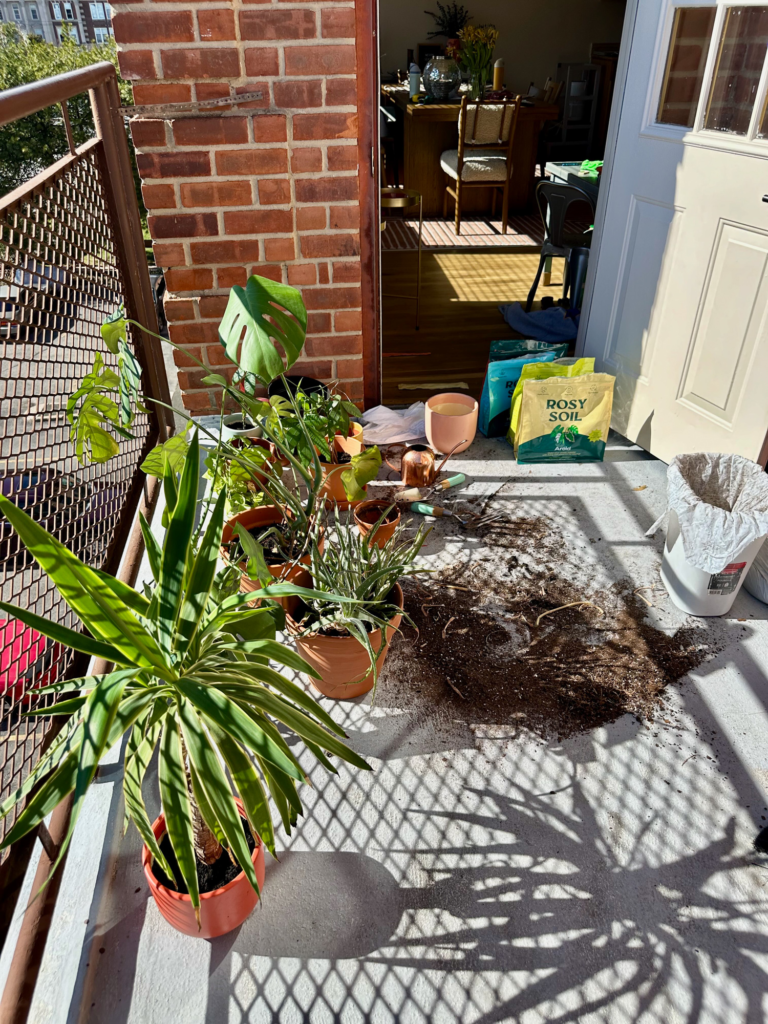
- A private outdoor terrace
- An extremely walkable location
- Two spacious bedrooms, two full bathrooms
- A top-floor corner unit with genuinely spacious interiors
- Room for an actual dining room table– something I hadn’t had since I moved out of my childhood home over 15 years ago
- A functioning kitchen with good bones and a lot of potential
- Bonus: a pool
The financial case made sense too. Our rent had climbed to $4,000 a month, with another $300 increase on the horizon at renewal. Between our mortgage and maintenance fee now, we’re saving over $500 a month (would be $800 had we continued our lease) compared to that rent.
Property taxes in our area for single-family homes were running $15,000–$25,000 a year. Add that to a mortgage, and we were looking at $7,000 a month in mortgage and taxes for a single family home.
When I told my parents our maintenance fee was $1,700 a month, they gasped because their HOA in their condo in Connecticut just $250. Instead, we sat down and broke down their costs for their primary home in New Hampshire: taxes, water, gas, exterior upkeep, anything that would be included in our maintenance fee. Once we added it up, theirs came out to about $200 more a month than ours. My family loves to knock condo living, but the reality is maintenance fees look scary in isolation. They look a lot different when you add in the full context of owning a single family home.
At around 1,400 square feet, this condo gives us the physical and financial space we need. That’s the goal we were actually chasing: not square footage for its own sake, but room to travel more, add a vacation home down the line, and live without that constant hum of financial stress. In this economy, in this moment, that peace of mind was worth more to us than a yard.
The Cons: What We’d Warn You About
If you want the honest downside of buying a condo specifically– not homeownership in general– it’s the process I already walked you through above: that board application. It felt antiquated. A manual form dressed up as a digital one, asking us to re-enter the same information over and over, with a profile system that promised to save us time and then didn’t. All wrapped up in fees.
The back-and-forth with the management company was its own frustration– chasing down information they honestly should have already had on file. That’s a story I’ll save for when I’m sitting on the board one day.
If I’m giving future condo buyers one piece of advice: budget extra time and extra money for the application process itself, separate from your mortgage. Dedicate time to working on this application because it is its own small project.
The Walkthrough and a Few Small Fixes
We waived our inspection contingency and instead did a thorough walkthrough ourselves. Three small things needed attention:
- A deteriorated valve behind the hot water in our primary shower, which we replaced
- A dishwasher that was brand new but hadn’t been installed properly
- A leaky toilet in the kids’ bathroom, an easy fix
Beyond that, the building itself is financially healthy, and it was clear the board and residents have taken good care of it– which, after everything I just told you about that application, felt like a nice bit of reassurance that all that paperwork was at least protecting something worthwhile.
Closing Day
I don’t know why we were so nervous again. Excitement and joy, mostly, but nerves too.
We did a walkthrough a few hours before closing, and everything looked good. We got to the closing first, before anyone else, in a boardroom at a lawyer’s office, staring down a stack of paper that felt a mile high.
Around the table: our lawyer, our Realtor, our mortgage lender, me and Fatima, the seller, his lawyer, and the closing attorney. The closing attorney made copies of everything, passed the stack around, and we signed. Our lawyer gave us the shorthand version of each document, we signed, and moved to the next one. We did that for about an hour straight.
Then the keys were handed over. Somehow, after all those months, that moment felt almost anticlimactic. That was until we drove to the condo with our kids and told them, this is our new home. Watching their faces when they saw their big bedrooms made the whole eleven weeks worth it.
One funny note: the seller told us he thought he’d collected all the spare keys from his neighbors, who’d been cat-sitting over the years, but he wasn’t totally sure. Over our first few weeks there, two more sets of keys turned up, haha.
The Real Numbers: What We Actually Paid
Here’s the full breakdown on the road to closing, line by line:
| Item | Cost |
|---|---|
| Earnest money deposit (due at offer acceptance) | $46,000 |
| Board application fees | $985 (application + credit report + digital submission) |
| Closing costs | $8,100 |
| Remaining down payment (cash) | $100,000 |
| Realtor fee | $4,700 |
| Lawyer fee | $3,000 |
| Building move-in fee (refundable after move) | $500 |
| First monthly maintenance | $1,740 |
Watching $165,000 leave our bank accounts over two months was stressful.
What’s Next
The second we closed, we called our contractor. Our renovation plan needed the building’s approval too and that came through in late November, which gave us until December 30th, before we moved in, to get the essentials done: refinishing and staining the floors, painting, new doors, and a new closet build. We also swapped out light fixtures throughout, which I’d genuinely recommend to anyone looking for an instant, affordable way to make a space feel like yours before moving in.
I’ll walk through all of that (the timeline, the budget, what we learned) in the following posts. For now: we signed the papers, got the keys, and told our kids we found our new home–all on the same day.